BOURGEON CAPITAL MARKET INSIGHTS
The market is a continuous dance, and the key to survival is to dance close to the door. - George Soros
Having just finished a tumultuous quarter in both bonds and stocks, it is an opportune moment to reflect on where we have been, where we are now, and where we are going. We are fortunate to be afforded extra space and time for reflection due to continued outperformance across client accounts.
Clearly, the dramatic rise in interest rates over the last 45 days to levels not seen in more than 20 years has introduced a significant new dynamic to the financial and economic landscape. So too has the dramatic swing in prevailing views on the AI buildout through data centers, the political backlash over higher electric rates and tax giveaways, not to mention broader concerns surrounding the rapid advancement of AI itself.
Before we delve further, let us briefly cover year-to-date performance. On the equity side, we were up about 2% for the quarter and around 22-23% year to date, putting us roughly 850-1,000 basis points ahead of the S&P 500. On the fixed income side, individual bonds and bond funds have experienced some of the most severe selling in more than a decade, with our bond portfolios ending the period down about -2% year to date.
Making Hay While the Sun Shines
Our continued equity outperformance has come from a combination of our individual stock picks, sector weightings and decisions around monetizing gains where we feel appropriate. Because we were fortunate to have been in many sectors and stocks before the market fully recognized their value, we were also able to trim or eliminate some positions before the market realized they had become overpriced. That allowed us, on more than several occasions, to redeploy funds into new, yet-to-be-discovered “shiny balls,” as we like to call good companies and themes that have not yet been fully recognized.
There are two outcomes from this. First, turnover can preserve large profits and help us avoid meaningful downside. Second, clients can end up with larger tax bills. While we obviously try to minimize taxes, we are more concerned with preserving and growing long-term capital.
In the last few years, all of us have been fortunate to own four or five stocks that have gone up 3-6x in less than a year. It is hard to recall ever seeing such significant appreciation in 46 years of investing in large-cap stocks, particularly over such a short period. To us, that is evidence of a frothy market in certain areas. Our thought process has been that we are willing to give up some potential outperformance to preserve total return and reduce overall risk. Always happy to discuss this in greater detail.
Not Much Relief In Sight
The Iran conflict was initially an exogenous shock to the world economy, but its persistence has raised concerns that may be further reaching for U.S. equity investors. As both sides remain dug in and move between kinetic conflict and bellicose negotiations, the risk of a serious mistake and further escalation remains high.
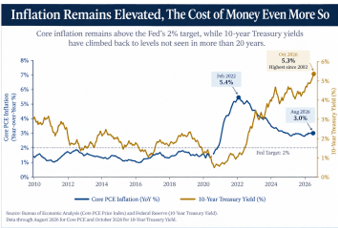
At the same time, even though oil continues to leave the Middle East, the world remains dangerously tight on petroleum products, including liquid natural gas. Consumers and business owners do not focus simply on the price of crude oil; they feel gasoline, diesel, and other petroleum products directly as inputs. Those prices remain extremely high, inventories are low, and there is simply not much room for another problem.
Inflation also remains stubbornly high, with price pressures showing up in ways that have made the Fed’s job increasingly difficult. Interest rates have moved sharply higher to levels not seen in more than 20 years, with little indication that meaningful relief is imminent.
Meanwhile, the consumer is beginning to show some strain. Employment remains relatively healthy, but wage growth has slowed, job opportunities have become less plentiful—particularly for recent college graduates—and higher prices and borrowing costs continue to weigh disproportionately on middle- and lower-income households. Consumer sentiment has fallen to a 12-year low, yet spending has remained surprisingly resilient—for now. That disconnect bears watching.
AI, Data Centers and Growth
On the growth side, the current “shiny ball” of AI proliferation, data center expansion and trillions of dollars of associated capital spending has begun to encounter some meaningful obstacles.
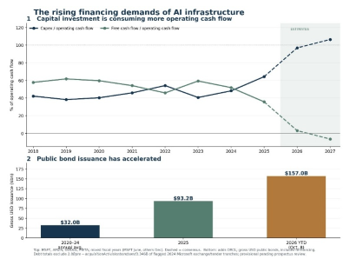
First, the economics of the companies leading the buildout are changing. Many entered this cycle with record free cash flow, extraordinary margins and premium valuations. Increasingly, however, those cash flows—and now substantial amounts of debt—are being redirected toward a once-in-a-generation infrastructure buildout without a clear understanding yet of the ultimate return on that invested capital.
That is a meaningful change for companies long celebrated for highly efficient, capital-light business models. Higher interest rates only complicate the equation. When margins and valuation multiples both begin at elevated levels, a materially higher cost of capital matters.
The second challenge is physical and political. Data centers require enormous amounts of power, electricity costs are rising for consumers, and rapid expansion into local communities has created a political backlash that we do not believe will disappear quickly. Water is becoming another point of contention, as cooling systems can require substantial amounts of it, often in communities where supplies are already strained. Competition for these resources can increase costs for local consumers and businesses, adding another layer of political and regulatory resistance. Power availability, transmission constraints, permitting and good old-fashioned NIMBY concerns are already slowing projects and increasing costs.
This brings us to something we always focus on as investors: time.
Projects do not have to be canceled for their economics to change. They just have to be delayed. If capacity that once appeared likely in 2027 instead arrives in 2028 or 2029, costs continue accumulating while revenues and returns move further into the future. The ultimate AI opportunity may remain enormous, but the path becomes longer, more expensive, and less certain.
The prospect of more than $4 trillion of AI and data center investment, once viewed almost entirely as an extraordinary growth catalyst, is therefore beginning to raise questions as well as excitement. Investors are starting to focus again on capital intensity, financing costs, return on invested capital and, importantly, the timing of those returns.
None of this negates the transformative potential of AI. We are big believers and large investors in the theme. We simply think the market has begun to price in a great deal of success while leaving less room for delay or disappointment.
Acknowledging the Risks and Opportunities
That brings us to how we are positioning portfolios. Corporate margins and earnings remain near historic highs, interest rates are at 20-year highs, and market performance has been driven by an unusually narrow group of companies. Any sustained change in the AI growth narrative could therefore create meaningful volatility that we do not believe is fully reflected in current valuations.
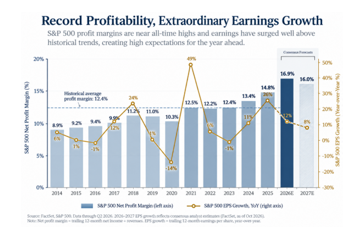
As discussed earlier, we have been modestly reducing exposure to some of the more richly valued names. At the same time, we remain significant holders of three of the largest participants in the AI buildout: Microsoft, Alphabet and Amazon.
Their existing businesses generate enormous cash flow, and their scale, talent and competitive advantages give them the resources to keep investing if conditions become more challenging. We would rather concentrate our exposure among the handful of companies with the financial strength and durable moats to keep going if things get tougher.
One of our highest conviction themes for the next three to five years also remains power and the infrastructure surrounding it. Regardless of the ultimate pace of AI adoption, the U.S. needs substantially more electricity generation and transmission capacity. Without it, there can be no sustained leadership in AI and data centers, broad electrification of transportation and industry, or meaningful relief from rising electricity costs.
Our definition of the power opportunity is intentionally broad: solar, wind, nuclear and natural gas generation, transmission infrastructure, critical materials and electrical equipment manufacturing.
We also continue to see attractive long-term opportunities across defense, aerospace and space, healthcare and biotechnology, industrials, and selected areas of technology.
Financials have enjoyed a strong run and have recently pulled back. A more favorable yield curve, improving loan growth and stronger investment-banking activity should remain supportive, although some of the easiest gains may now be behind the sector. Over time, traditional financial institutions will also have to contend with increasing fintech competition and the accelerating use of AI throughout the industry.
Structural Dynamics
Much has been made of the idea that AI, fintech and data technology have permanently changed investing, leaving a relatively small group of technology companies to dominate market returns. AI may ultimately prove as transformative as the Industrial Revolution or the Internet, but these transitions take time. Nothing moves in a straight line forever, and declaring large portions of the market permanently irrelevant seems premature.
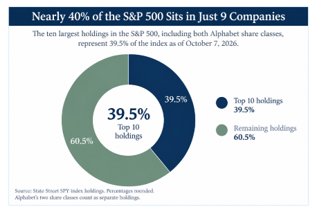
What has clearly changed is market structure. An increasing share of investment flows directly into ETFs and index funds, while traditional stock picking has become less prevalent. We think that creates opportunity.
Greater concentration and less attention paid to individual companies can create inefficiencies for investors willing to do the work. Put differently, there may be more opportunities to find the next “shiny ball” before the market does.
Government debt is another structural concern. U.S. debt and annual deficits have reached levels that will become increasingly difficult to ignore, particularly now that interest rates are materially higher than they were a few years ago. Medicare and Social Security add to those longer-term fiscal pressures, while meaningful solutions remain political lightning rods for both parties.
Energy security has also reemerged as a significant economic issue. COVID, the invasion of Ukraine and more recent geopolitical disruptions have exposed vulnerabilities in global energy supply chains. Building a more secure and resilient energy system will require substantial investment. That reinforces our long-term power thesis, but it will also be costly and potentially inflationary.
Despite all of this, equity markets have continued higher. We remain constructive and fully invested in many of the themes driving that performance, but we also think complacency has risen.
Historically, after periods like this, something eventually “breaks.” Sometimes it is something completely unexpected. Other times it is simply the cumulative effect of higher rates, weaker credit, multiple compression, disappointing returns on invested capital or earnings that arrive later than expected because costs and depreciation have moved ahead of revenues.
The market has enjoyed an excellent five-year run, and our accounts an exceptional two-year run. We think it behooves us to be somewhat more cautious as the next six months play out.
As we wrote in one of our older letters: “Enjoy the party, but dance near the door.” That still feels appropriate today.
Portfolio Activity
Even with this more cautious posture, we made several portfolio changes during the quarter.
We initiated a 1.5% position in biotech company that has a promising new product and an interesting pipeline. We expect to add to the position as the story develops in line with our expectations.
We also added a large natural gas producer, as another component of our broader power theme. Our thesis extends beyond increasing natural gas demand from utilities and behind-the-meter generation for data centers to additional pipeline infrastructure and increased U.S. exports to meet global demand.
Within semiconductors, we added one new and less well-known name and increased our position in an existing holding as strength in the industry has begun to broaden beyond the usual leaders. The existing position has been somewhat disappointing over the past year but is finally receiving more recognition for its product diversity, attractive valuation and expanding AI capabilities, which we believe remain underappreciated.
Finally, we continued to trim some of our largest technology winners, including a cybersecurity position and a software name. We also harvested tax losses in where we could and have recently begun rebuilding those positions.
Alternatives in Bourgeon Portfolios
We differentiate our alternative strategies between: Private Equity, Private Infrastructure, Private Credit, and Private Real Estate. We also consider Real Assets to be an alternative exposure, but we access this through a fully liquid, daily traded mutual fund.
Private Credit continues to limit the amount of money investors can get back relative to what they are requesting. This feature, designed to protect existing investors who choose to stay in the fund, makes for bad headlines and will take time to normalize. The general trend this quarter was fewer redemption requests but still elevated. We continue to believe in the credit strategies to which we have allocated. They continue to perform in line with expectations, and we have begun to see recovery in reported Net Asset Values from their recent lows.
Private infrastructure, equity, and real estate funds are having good years. Real assets are also having a good year as persistently sticky inflation is a tailwind to the strategy. We continue to believe that alternative strategies warrant consideration for inclusion in broadly diversified portfolios, so long as holdings are sized appropriately and liquidity constraints are taken into consideration.
Model Portfolio
Our model portfolios are up nicely for the year. The strategies range from Aggressive to Conservative, and those strategies with higher exposure to fixed income have more muted returns as that asset class has been a drag in 2026. This is a similar dynamic to 2022 when fixed income, traditionally considered a safe asset class aligned with more conservative investors, significantly weighed on account performance. It is worth a reminder that should the economy or the stock market hit a difficult period, a common policy reaction function is for rates to be cut, potentially lifting bond prices in a way that serves one of the intended purposes of holding fixed income: ballast in a storm. The international equity side has been particularly interesting this year. Both South Korea and Taiwan have experienced explosive rises in equity markets due to their concentrated weightings of a few tech powerhouses that are highly levered to the AI buildout. Our model portfolios did capture some of this appreciation, but some of our chosen investments were underweight these markets, resulting in modest underperformance relative to benchmarks.
In August, we made a small rebalance to sell some S&P 500 exposure as it made a new high, and we moved those proceeds into fixed income as yields began to rise. The fourth quarter may see more rebalancing of a similar fashion as we keep an eye on the move in yields.
Yields Move Higher as Inflation Pressures Persist
Bond markets remained volatile during the quarter as persistent inflation reduced expectations for lower interest rates. In September, the Federal Reserve raised its benchmark interest rate by 0.25 percentage points to a range of 3.75%–4.00%. With economic growth and the job market holding up, the Fed has room to keep rates elevated as it works to bring inflation back toward its 2% target.
Tensions in the Middle East added to the uncertainty. Disruptions to oil supplies and risks to key shipping routes have kept energy prices elevated, potentially slowing progress on inflation. Although emergency oil reserve releases and increased production have offered some relief, further disruptions remain a concern.
Treasury yields rose across a range of maturities, putting pressure on existing bond prices while offering more income on new purchases. As of October 8, yields were approximately 4.3% for two-year Treasuries and 5.2% for ten-year Treasuries. We see opportunities to lock in attractive income through high-quality bonds, while selecting maturities that align with each client’s needs and long-term goals.
This letter should not be relied upon as investment advice. Any mention of particular stocks or companies does not constitute and should not be considered an investment recommendation by Bourgeon Capital Management, LLC. Any forward-looking statement is inherently uncertain. Due to changing market conditions and other factors, the content in this letter may no longer reflect our current opinions. Different types of investments involve varying degrees of risk, and there can be no assurance that the future performance of any specific investment, investment strategy, or product made reference to directly or indirectly in this letter will be profitable or suitable for your individual portfolio. In addition, past performance is no indication of future results. Please contact us if you have any questions regarding the applicability of any matter discussed in this letter to your individual situation. Please contact us if your financial situation or investment objectives change or if you wish to impose new restrictions or modify existing restrictions on your accounts. Our current firm brochure and brochure supplement is available on the website maintained by the Securities and Exchange Commission or from us upon request. You should be receiving, at least quarterly, statements from your account custodian or custodians showing transactions in your accounts. We urge you to compare your custodial statements with any reports that you receive from us.